
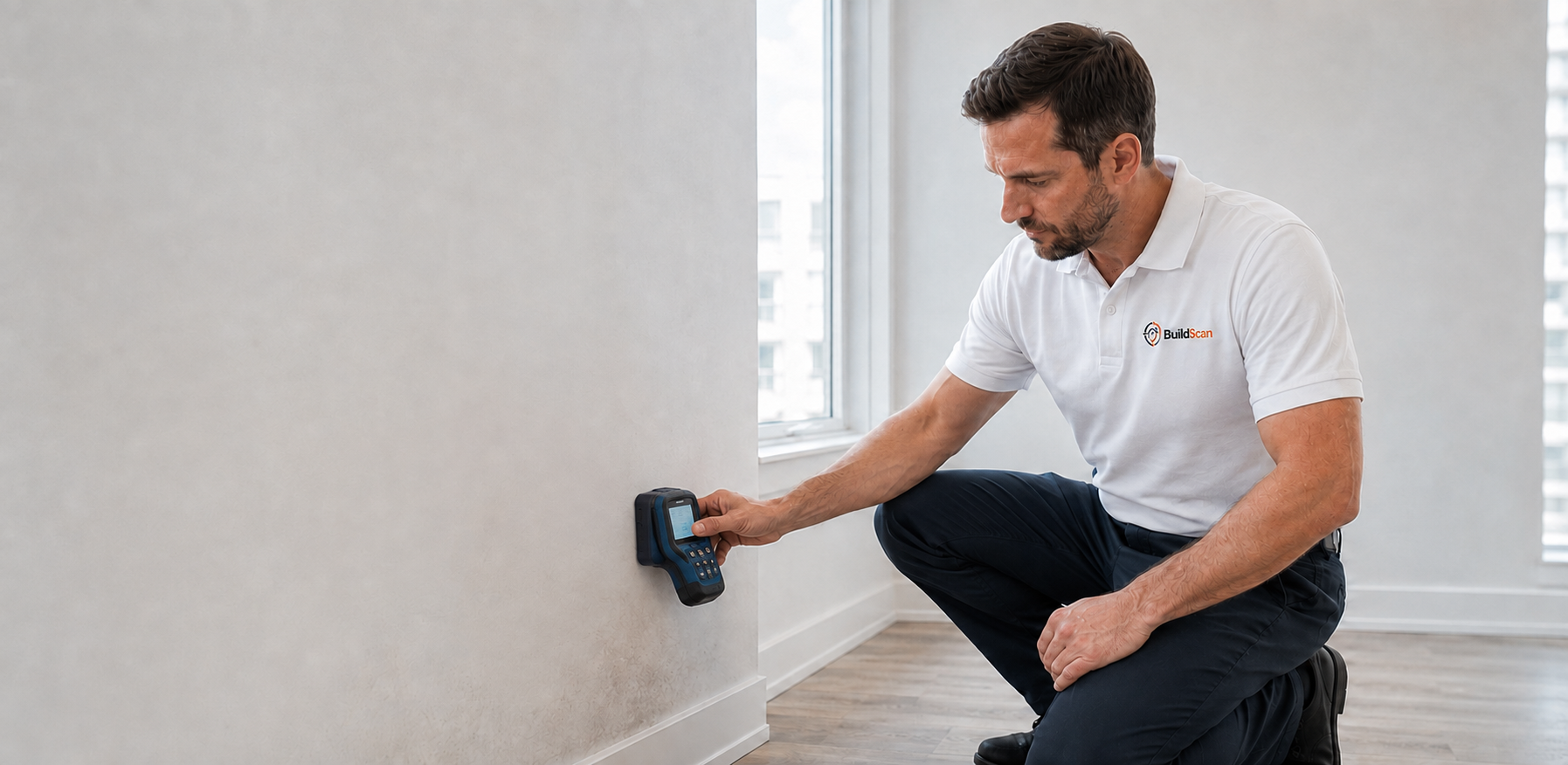
Non-invasive investigation for damp and infiltration
We measure the suspect areas, document the context and explain what the result may indicate. When the cause cannot be established visually, we recommend the next investigation.
A damp investigation documents the affected areas and measures the moisture of air and surfaces, non-invasively, at the points where visual indications exist. Every value is reported against the room, the measured point and the conditions at the time of the visit.
The symptoms are often identical while the causes differ: condensation from insufficient ventilation and thermal bridges, infiltration from outside, a leak in an installation, rising damp or residual moisture after works. For that reason we state evidence-based hypotheses rather than categorical conclusions.
The service can be booked on its own or as a module within a broader property inspection.
Condensation or infiltration
Condensation usually appears on cold surfaces, in poorly ventilated areas, in corners, behind furniture or around joinery, and is influenced by how the home is used: number of occupants, cooking, drying laundry, airing.
Infiltration usually has an identifiable point of origin and follows a path: from the roof, terrace, façade, a joint, poorly sealed joinery or an installation. We document the shape, extent and position of the affected area, which helps distinguish between the two situations.
Distinguishing them is not always possible from a single visit, especially when the damp is old or has been covered by repairs. When the data does not support a conclusion, we say so explicitly.
What we measure
All measurements are non-invasive and carried out without cuts or drillings.
- Relative humidity and air temperature in the relevant rooms.
- Surface moisture, with non-invasive sensor instruments, at suspect points and at reference points considered dry.
- Surface temperature differences with the thermal camera, where conditions allow a reasonable interpretation.
- Context: existing ventilation, moisture sources from occupancy, condition of joinery, appearance of the façade in the affected area.
What conditions influence the result
A moisture measurement is a snapshot of a moment. Results depend on the season, the weather in the preceding days, the indoor temperature, the airing done before the visit and the materials of the measured surface.
That is why we record the conditions of the visit in the report. A high value on a rainy day and a normal value after a dry spell can describe the same problem at different stages.
Thermal imaging and endoscopy where access exists
Thermal imaging highlights temperature differences that can point the investigation towards a thermal bridge, a damp area or a discontinuity in the insulation. It does not see through walls and does not prove the presence of water on its own.
Endoscopic inspection is carried out only through openings or access points that already exist, for example junction boxes, service joints or inspection spaces. We make no cuts, drillings or dismantling in order to insert the camera.
What you receive
A report that clearly separates what was observed, what was measured and what it may mean.
Limits of the investigation
A BuildScan inspection is a private, visual, non-invasive and informative service. We state explicitly what falls outside its scope, so you know from the start where our conclusions stop.
- It is not an authorised technical expert report, a design review, an official handover of works, nor an ANEVAR valuation.
- We issue no legal certification and take no position on whether the building complies with its permit or technical documentation.
- We make no cuts, drillings, demolitions or dismantling; we check what is visible and accessible at the time of the visit.
- We cannot confirm the condition of elements hidden inside the structure, screeds, walls or spaces without access.
- We do not guarantee that the source of the damp will be identified from a single visit and promise no definitive diagnosis.
- We carry out no pressure tests on installations, no tracer tests, no laboratory analyses, and we do not identify mould species.
- Endoscopy is carried out exclusively through existing openings or access points, without cuts, drillings or dismantling.
Price and quotation
For the damp investigation we publish no separate rate: the price and the way it is included depend on the purpose of the check and on the inspection variant chosen. The investigation can be booked for one or two specific areas or included as a module within a full property inspection.
Describe the affected areas, when they appeared and what works have been carried out, and we will confirm the scope and the price by quotation. Details of the inspection variants are on the pricing page.
Frequently asked questions
Direct answers to the questions we receive most often before booking.
Will you certainly find the source of the damp?
We cannot promise that. We measure, document and state hypotheses supported by evidence. In many cases the data indicates a probable cause, but confirming it may require further checks, for example pressure tests on installations or interventions beyond a non-invasive method.
Do you open up walls to check?
No. The service is non-invasive and non-destructive. We use surface sensor instruments, a thermal camera and, where openings or access points already exist, an endoscopic camera. We make no cuts, drillings or dismantling.
What temperature is needed for thermal imaging?
Thermal imaging gives interpretable results when there is a sufficient difference between indoor and outdoor temperature, usually in the cold season or early in the morning. Without that difference the images may be inconclusive, and this is recorded in the report.
Do you also measure air humidity?
Yes. We record relative humidity and air temperature in the relevant rooms, because recurring condensation depends on those values and on ventilation, not only on the state of the surface.
When is a plumber or an expert needed?
When the data indicates a leak in an installation under a screed or inside a wall, when the affected area spreads quickly, when associated cracks appear, or when tests and interventions are required that a non-invasive method cannot perform. In such cases we explicitly recommend the right specialist.


%20scale(0.5873015873015873%200.5882352941176471)'%20d='M0%200H62V16H18V36H55V53H18V85H0Z'/%3e%3cpath%20transform='translate(45%201)%20scale(0.6470588235294118%200.5882352941176471)'%20d='M0%200H17V85H0Z'/%3e%3cpath%20transform='translate(66%201)%20scale(0.6197183098591549%200.5882352941176471)'%20d='M0%2085V0H33C55%200%2067%2010%2067%2027C67%2040%2062%2048%2049%2052C48%2052.3%2048%2053%2048.6%2053.8L72%2085H51L29%2055C28.5%2054.3%2027.5%2054%2026%2054H17V85Z%20M17%2015V40H33C44%2040%2049%2035%2049%2027C49%2019%2044%2015%2033%2015Z'/%3e%3cpath%20transform='translate(113%200)%20scale(0.5909090909090909%200.5909090909090909)'%20d='M64%2012L53%2025C46%2019%2040%2016%2031%2016C23%2016%2018%2019%2018%2025C18%2031%2024%2034%2035%2037C55%2042%2066%2049%2066%2064C66%2080%2053%2088%2034%2088C19%2088%208%2084%200%2074L12%2061C18%2068%2026%2072%2035%2072C44%2072%2049%2069%2049%2064C49%2058%2044%2056%2030%2052C11%2047%200%2040%200%2026C0%209%2013%200%2032%200C45%200%2057%204%2064%2012Z'/%3e%3cpath%20transform='translate(156%202)%20scale(0.5972222222222222%200.5764705882352941)'%20d='M0%200H72V16H45V85H27V16H0Z'/%3e%3cpath%20transform='translate(1%2064)%20scale(1.0%201.0)'%20d='M0%2085V0H33C56%200%2068%2010%2068%2027C68%2045%2055%2054%2033%2054H17V85Z%20M17%2015V40H32C44%2040%2050%2035%2050%2027C50%2019%2044%2015%2032%2015Z'/%3e%3cpath%20transform='translate(77%2064)%20scale(1.0%201.0)'%20d='M0%2085V0H33C55%200%2067%2010%2067%2027C67%2040%2062%2048%2049%2052C48%2052.3%2048%2053%2048.6%2053.8L72%2085H51L29%2055C28.5%2054.3%2027.5%2054%2026%2054H17V85Z%20M17%2015V40H33C44%2040%2049%2035%2049%2027C49%2019%2044%2015%2033%2015Z'/%3e%3cpath%20transform='translate(156%2064)%20scale(0.9411764705882353%201.0)'%20d='M0%200H17V85H0Z'/%3e%3cpath%20transform='translate(183%2064)%20scale(1.0%201.0)'%20d='M0%2085V0H15L55%2053V0H71V85H59L17%2031V85Z'/%3e%3cpath%20transform='translate(261%2064)%20scale(1.0%201.0)'%20d='M79%2017L65.5%2026C60%2018%2053%2014%2043%2014C27%2014%2017%2027%2017%2042.5C17%2059%2027%2072%2043%2072C53%2072%2061%2067%2066%2058L80%2067C72%2080%2058%2087%2043%2087C18%2087%200%2068%200%2042.5C0%2018%2018%20-1%2043%20-1C58%20-1%2072%205%2079%2017Z'/%3e%3cpath%20transform='translate(348%2064)%20scale(1.0%201.0)'%20d='M0%200H17V85H0Z'/%3e%3cpath%20transform='translate(376%2064)%20scale(0.9852941176470589%201.0)'%20d='M0%2085V0H33C56%200%2068%2010%2068%2027C68%2045%2055%2054%2033%2054H17V85Z%20M17%2015V40H32C44%2040%2050%2035%2050%2027C50%2019%2044%2015%2032%2015Z'/%3e%3cpath%20transform='translate(448%2064)%20scale(1.0%201.0)'%20d='M0%200H17V70H59V85H0Z'/%3e%3cpath%20transform='translate(513%2064)%20scale(1.0%201.0)'%20d='M0%200H61V15H18V34H52V49H18V70H62V85H0Z'/%3e%3cellipse%20cx='595'%20cy='139.5'%20rx='11'%20ry='10.5'/%3e%3c/g%3e%3c/svg%3e)
%20scale(0.5873015873015873%200.5882352941176471)'%20d='M0%200H62V16H18V36H55V53H18V85H0Z'/%3e%3cpath%20transform='translate(45%201)%20scale(0.6470588235294118%200.5882352941176471)'%20d='M0%200H17V85H0Z'/%3e%3cpath%20transform='translate(66%201)%20scale(0.6197183098591549%200.5882352941176471)'%20d='M0%2085V0H33C55%200%2067%2010%2067%2027C67%2040%2062%2048%2049%2052C48%2052.3%2048%2053%2048.6%2053.8L72%2085H51L29%2055C28.5%2054.3%2027.5%2054%2026%2054H17V85Z%20M17%2015V40H33C44%2040%2049%2035%2049%2027C49%2019%2044%2015%2033%2015Z'/%3e%3cpath%20transform='translate(113%200)%20scale(0.5909090909090909%200.5909090909090909)'%20d='M64%2012L53%2025C46%2019%2040%2016%2031%2016C23%2016%2018%2019%2018%2025C18%2031%2024%2034%2035%2037C55%2042%2066%2049%2066%2064C66%2080%2053%2088%2034%2088C19%2088%208%2084%200%2074L12%2061C18%2068%2026%2072%2035%2072C44%2072%2049%2069%2049%2064C49%2058%2044%2056%2030%2052C11%2047%200%2040%200%2026C0%209%2013%200%2032%200C45%200%2057%204%2064%2012Z'/%3e%3cpath%20transform='translate(156%202)%20scale(0.5972222222222222%200.5764705882352941)'%20d='M0%200H72V16H45V85H27V16H0Z'/%3e%3cpath%20transform='translate(1%2064)%20scale(1.0%201.0)'%20d='M0%2085V0H33C56%200%2068%2010%2068%2027C68%2045%2055%2054%2033%2054H17V85Z%20M17%2015V40H32C44%2040%2050%2035%2050%2027C50%2019%2044%2015%2032%2015Z'/%3e%3cpath%20transform='translate(77%2064)%20scale(1.0%201.0)'%20d='M0%2085V0H33C55%200%2067%2010%2067%2027C67%2040%2062%2048%2049%2052C48%2052.3%2048%2053%2048.6%2053.8L72%2085H51L29%2055C28.5%2054.3%2027.5%2054%2026%2054H17V85Z%20M17%2015V40H33C44%2040%2049%2035%2049%2027C49%2019%2044%2015%2033%2015Z'/%3e%3cpath%20transform='translate(156%2064)%20scale(0.9411764705882353%201.0)'%20d='M0%200H17V85H0Z'/%3e%3cpath%20transform='translate(183%2064)%20scale(1.0%201.0)'%20d='M0%2085V0H15L55%2053V0H71V85H59L17%2031V85Z'/%3e%3cpath%20transform='translate(261%2064)%20scale(1.0%201.0)'%20d='M79%2017L65.5%2026C60%2018%2053%2014%2043%2014C27%2014%2017%2027%2017%2042.5C17%2059%2027%2072%2043%2072C53%2072%2061%2067%2066%2058L80%2067C72%2080%2058%2087%2043%2087C18%2087%200%2068%200%2042.5C0%2018%2018%20-1%2043%20-1C58%20-1%2072%205%2079%2017Z'/%3e%3cpath%20transform='translate(348%2064)%20scale(1.0%201.0)'%20d='M0%200H17V85H0Z'/%3e%3cpath%20transform='translate(376%2064)%20scale(0.9852941176470589%201.0)'%20d='M0%2085V0H33C56%200%2068%2010%2068%2027C68%2045%2055%2054%2033%2054H17V85Z%20M17%2015V40H32C44%2040%2050%2035%2050%2027C50%2019%2044%2015%2032%2015Z'/%3e%3cpath%20transform='translate(448%2064)%20scale(1.0%201.0)'%20d='M0%200H17V70H59V85H0Z'/%3e%3cpath%20transform='translate(513%2064)%20scale(1.0%201.0)'%20d='M0%200H61V15H18V34H52V49H18V70H62V85H0Z'/%3e%3cellipse%20cx='595'%20cy='139.5'%20rx='11'%20ry='10.5'/%3e%3c/g%3e%3c/svg%3e)